
.svg)

The BDC Industry’s Dirty Secret is Not Leverage — It's the Fee Structure


If you want to understand what is broken in many BDCs, start with the fee structure.
Many investors assume a listed credit vehicle is broadly aligned with them: if shareholders do well, the manager does too. But that is not how most BDCs are built.
Unlike a typical credit fund, many BDCs pay their manager in three ways: a management fee, an incentive fee on income, and a separate incentive fee on capital gains. Critically, those incentive fee components are independent of one another. In other words, a manager can continue collecting incentive compensation on interest income even while shareholders are suffering heavy losses.
It gets worse.
The management fee is often charged on total assets, including assets purchased with borrowed money, rather than simply on shareholder equity. That creates a strong incentive for the manager to expand the balance sheet through leverage.
And leverage is far from trivial in this sector: qualifying BDCs can operate with asset coverage of 150%. Recent market snapshots show public BDC leverage averaging roughly 1.0x debt-to-equity, with several large platforms running materially above that level.
The chart says it all.
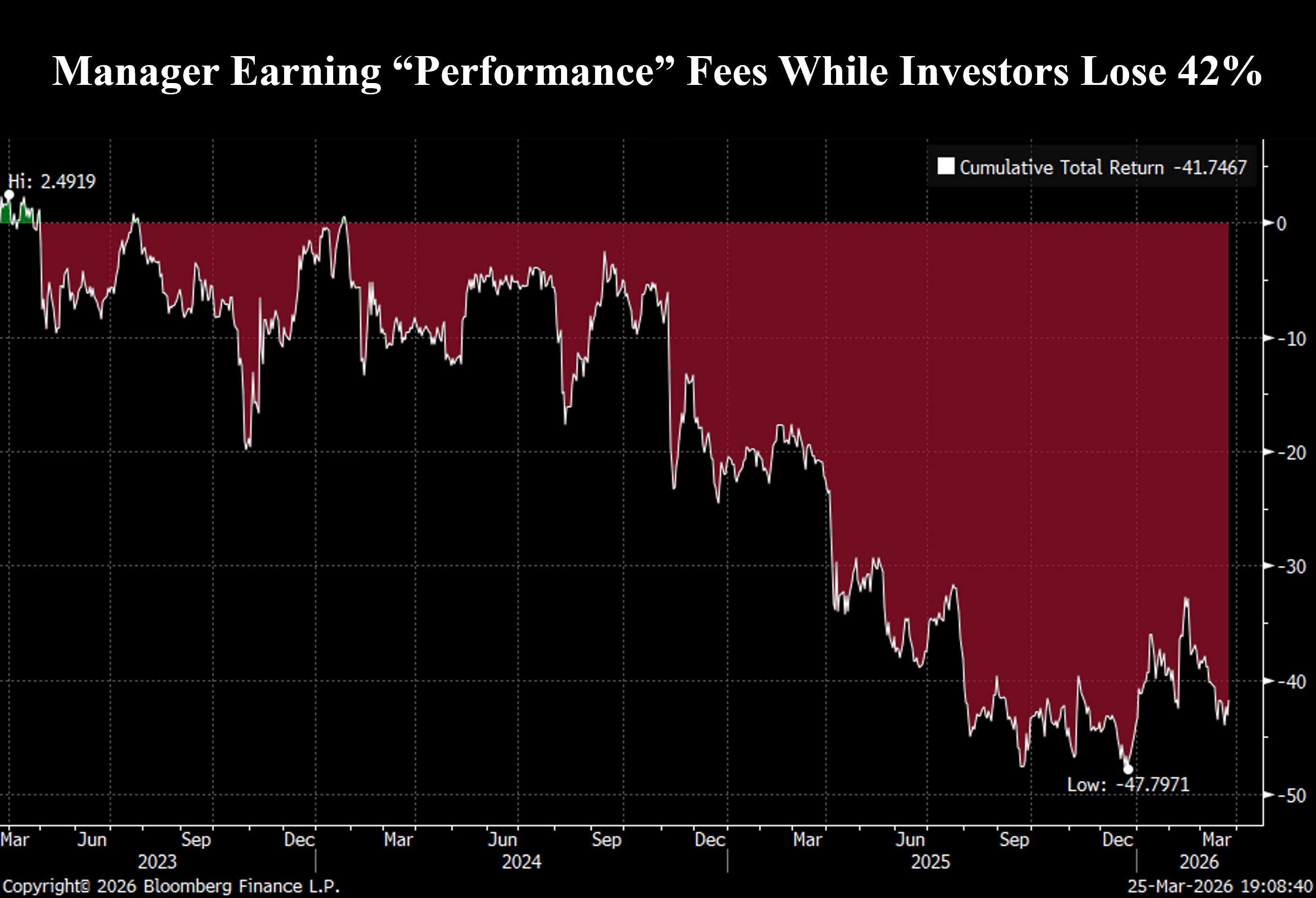
Over the past three years, this BDC manager earned a management fee averaging 4.3% per annum of shareholder equity, plus another 1.7% per annum in income incentive fees — more than 18% in aggregate — while shareholders lost roughly 42% on a total return basis.
The result? Investors down by nearly half while the manager got paid $629 million in fees.
Sound investing starts with alignment of interest. When the manager is paid on assets, paid on income, and still able to earn while shareholder capital is being destroyed, that alignment is badly compromised.
I'm not suggesting every BDC is a bad investment or that asset managers shouldn't receive a fair wage.
However, investors should stop looking only at dividend yields and discounts to NAV and start asking a more important question: who is the structure really designed to enrich?
The problem is not that the incentives are imperfect. It is that they are working exactly as intended.

.png)



.svg)


